
The Real Cost of Owning a Home in Florida:
What Your Home’s Age Tells You
Most buyers budget for a mortgage. Fewer budget for the roof, the AC, and the water heater — and in Florida, those systems don’t last as long as they do up north. After years of inspecting homes across Citrus County, I’ve noticed something else, too: a lot of homeowners aren’t able to keep up with maintenance the way they used to, and it isn’t because they’ve stopped caring. It’s because the cost of materials and skilled labor has climbed faster than most people’s annual salaries and budgets have. Here’s what “normal” maintenance actually costs, why it’s gotten harder to keep up with, and what to realistically expect depending on how old the home is.
Why Maintenance Is Getting Harder to Keep Up With
This isn’t just a feeling. Skilled trade labor — electricians, plumbers, HVAC techs — is in short supply nationwide, and hourly rates have climbed over 20% in the last few years in many areas. Industry data shows overall home repair costs rose nearly 18% between 2022 and 2025, while building materials like lumber, copper, and MEP (mechanical/electrical/plumbing) products have also climbed. None of this is unique to Florida, but our humidity, salt air, and storm exposure mean our systems already wear out faster than the national average — so rising costs hit Florida homeowners on top of a shorter maintenance cycle to begin with.
The practical result: the same repairs that used to be a minor annoyance are now a real budget item, and deferring maintenance has gotten more tempting — and more costly — at the same time.
What Annual Maintenance Really Costs
Between HVAC service, roof upkeep, pest control, plumbing, and the routine stuff most owners forget until it fails, a well-maintained Florida home typically runs $3,000–$6,000 a year in routine upkeep — filters, tune-ups, pest bonds, gutter cleaning, inspections. Add in the amortized cost of big-ticket replacements (roof, AC, water heater) that every home eventually needs, and national data puts average annual home maintenance spending between $4,000 and $22,000 a year depending on the home’s age, size, and condition — a range that lines up closely with what I see on inspections here.
The age of the home is what moves you from the low end of that range to the high end.
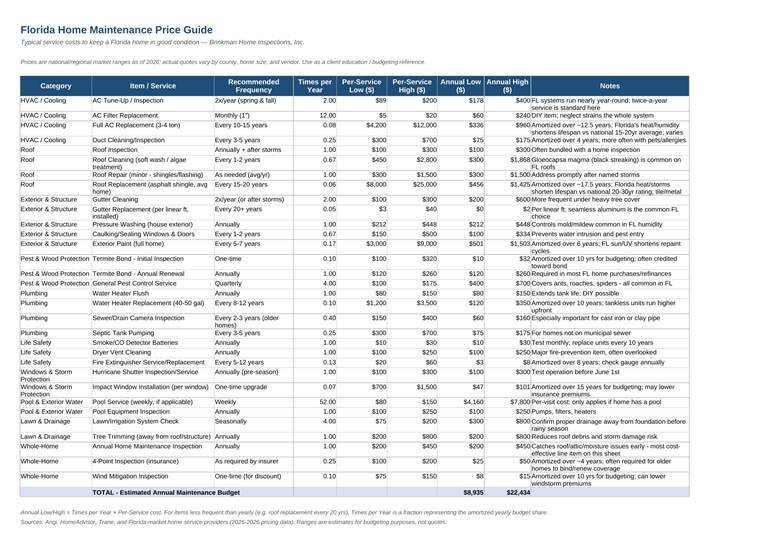
Florida Home Maintenance Price Guide — full breakdown by category, frequency, and estimated annual cost.
Homes 10–25 Years Old: Mid-Life Systems
These homes are usually past their builder-grade warranties but not yet at “everything’s original” territory. What buyers should realistically expect:
- Roof: Nationally, asphalt shingles are rated for 20–30 years, but Florida’s heat, humidity, and storms bring the realistic average down to roughly 15–20 years. Budget for a full inspection annually and expect algae staining (common on Florida roofs) needing a soft wash every 1–2 years.
- AC system: Florida units run nearly year-round, so the realistic lifespan here is closer to 10–15 years, compared to 15–20 years in milder climates. A 10–25 year old home often has its second AC system already, or is approaching that point. Expect tune-ups twice a year and budget for full replacement if it hasn’t happened yet.
- Water heater: Original units are usually near or past end-of-life (8–12 years). This is one of the more common surprise repairs in this age bracket.
- Windows, paint, caulking: Florida sun and humidity are hard on seals and exterior paint — expect a repaint cycle every 5–7 years and periodic re-caulking around windows and doors.
- Insurance: Most of these homes still qualify for standard coverage without major hurdles, though a wind mitigation inspection can help lower premiums if it hasn’t been done.
Bottom line: these homes are usually sound, but buyers should budget for one or two major system replacements (AC, water heater, or roof) within the first several years of ownership — not because anything is wrong, but because of where the home sits in its equipment lifecycle, and because replacement costs are higher today than they were even five years ago.
Homes 30–60 Years Old: Original Infrastructure Risk
This is where realistic expectations matter most, because the risk shifts from “systems are aging” to “systems may have never been replaced — or were installed with materials we no longer consider safe.”
- Electrical: Homes from certain eras may have panel brands like Federal Pacific Electric (FPE) “Stab-Lok” or Zinsco, both installed heavily from the 1950s through early 1980s. Independent testing has found FPE breaker failure-to-trip rates as high as 25–60%, and Zinsco panels have a documented history of breakers fusing to the bus bar instead of tripping. Many insurers now decline coverage or require replacement before writing or renewing a policy. Aluminum branch wiring also shows up in some 1960s–70s homes and typically requires evaluation.
- Plumbing: Polybutylene pipe — installed in an estimated 6–10 million U.S. homes between 1978 and 1995 — is prone to sudden, catastrophic failure as chlorine in the water supply breaks the material down from the inside. It’s often invisible until it bursts, and many insurers either exclude related water damage or decline coverage outright. Galvanized supply lines and cast iron drain lines, also common in this age range, bring their own corrosion and flow issues. A sewer camera inspection is worth the cost before closing.
- Roof & AC: If these haven’t been documented as replaced, assume they’re overdue. A roof this old is often the difference between qualifying for standard insurance and being pushed to a surplus-lines carrier.
- Insurance realities: Most Florida insurers require a 4-point inspection (roof, electrical, plumbing, HVAC) once a home reaches roughly 25–30 years old before they’ll write or renew a policy. This isn’t optional in most cases — budget the time and the cost into your closing process.
- Permitting history: Additions, garage conversions, and rewiring done decades ago may predate current permitting records. Unpermitted work can complicate both insurance and resale later.
Bottom line: these homes can be excellent value and are often built with materials (like solid block construction) that hold up structurally very well — but buyers should walk in expecting that electrical, plumbing, roofing, and HVAC are all candidates for near-term replacement, not just aging systems that still have years left.
The One Number That Changes Everything
Across both age ranges, the single biggest variable in what a home actually costs to own is whether prior maintenance was kept up or deferred. A well-maintained 45-year-old home can be a safer bet than a neglected 15-year-old one. And in today’s cost environment, staying on top of small maintenance items matters more than ever — because the gap between “minor repair” and “major replacement” has only gotten more expensive. That’s exactly what a home inspection is built to reveal — not just what’s broken today, but what’s likely coming in the next 1, 5, and 10 years, so you can budget for it instead of getting surprised by it.
If you’re buying a home anywhere in this age range in Citrus County, an inspection with Brinkman Home Inspections gives you a clear, honest picture of where the home really stands — so you know exactly what you’re walking into.
Sources
Florida Realtors – shingle roofs and wind resistance after 10 years: https://floridarealtors.org/news-media/news-articles/2025/02/shingles-lose-wind-resistance-after-10-years
Fox Haven Roofing – realistic asphalt shingle roof lifespan in Florida: https://foxhavenroof.com/?p=6251
HVAC.com – AC unit lifespan in Florida’s climate: https://www.hvac.com/expert-advice/how-long-do-air-conditioners-last-in-jacksonville/
AJ Long Electric – Federal Pacific / Zinsco panel failure rates and insurance impact: https://ajlongelectric.com/blog/federal-pacific-zinsco-panel-dangers
InterNACHI – Polybutylene pipe for inspectors: https://www.nachi.org/pb.htm
Chubb – Why a 4-point inspection is essential for Florida homeowners: https://www.chubb.com/content/chubb-sites/chubb-com/na/us/en/individuals-families/resources/why-a-4-point-inspection-is-essential-for-florida-homeowners.html
American Home Shield – rising cost of home maintenance and repairs: https://www.ahs.com/home-matters/homebuyer-hub-resources-and-guides/big-fixes-big-price-tags-the-rising-cost-of-home-maintenance-and-repairs/
Barchart – home repair costs rising faster than inflation in 2025: https://www.barchart.com/story/news/35350988/how-home-repairs-are-becoming-more-expensive-in-2025-and-what-it-means-for-homeowners
Note: figures above are industry-wide averages meant for general education, not a guarantee of costs for any specific property. Always get current, local quotes before budgeting a major repair or replacement.
Printable General Price Sheet Below: